What is Brothers: A Tale of Two Sons Games?
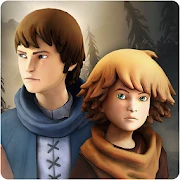
Brothers: A Tale of Two Sons is an emotionally driven adventure game created by Starbreeze Studios and directed by Josef Fares, first released in 2013. Players control two young brothers simultaneously, each guided with one side of the controller or separate input schemes, which creates an intimate sense of cooperation even during single-player sessions. The narrative centers on a journey to find a cure for their ailing father, and the game unfolds like a fable, blending fairy-tale motifs with grounded human emotion. Puzzles are integrated into the world design rather than appearing as isolated minigames, and many challenges require coordinating the brothers' actions to traverse obstacles, manipulate objects, and solve environmental riddles. The pacing balances quieter moments of character interaction with short bursts of action and set-piece moments, maintaining a steady emotional arc throughout a relatively compact playtime. Visuals adopt a stylized realism, with landscapes that feel both magical and melancholic; cinematography and camera framing emphasize the relationship between the characters and their surroundings. Audio design plays a central storytelling role, with a musical score that accentuates mood shifts and minimal dialogue conveyed through expressive vocalizations rather than full spoken language, deepening the sense of universality in the tale. The game's structure encourages players to reflect on themes such as loss, cooperation, and maturity, offering multiple poignant moments that linger after the credits roll. While its mechanics are approachable, the intentional limitations on direct communication and complex tutorials invite players to learn through trial, observation, and empathy, crafting an experience that feels both intimate and carefully authored. This combination of narrative focus, inventive control, and aesthetic cohesion makes Brothers a distinctive entry in narrative-driven adventure games. Its brief runtime encourages repeated playthroughs to appreciate small details, alternate interpretations, and the emotional resonance of its crafted sequences across different player perspectives.
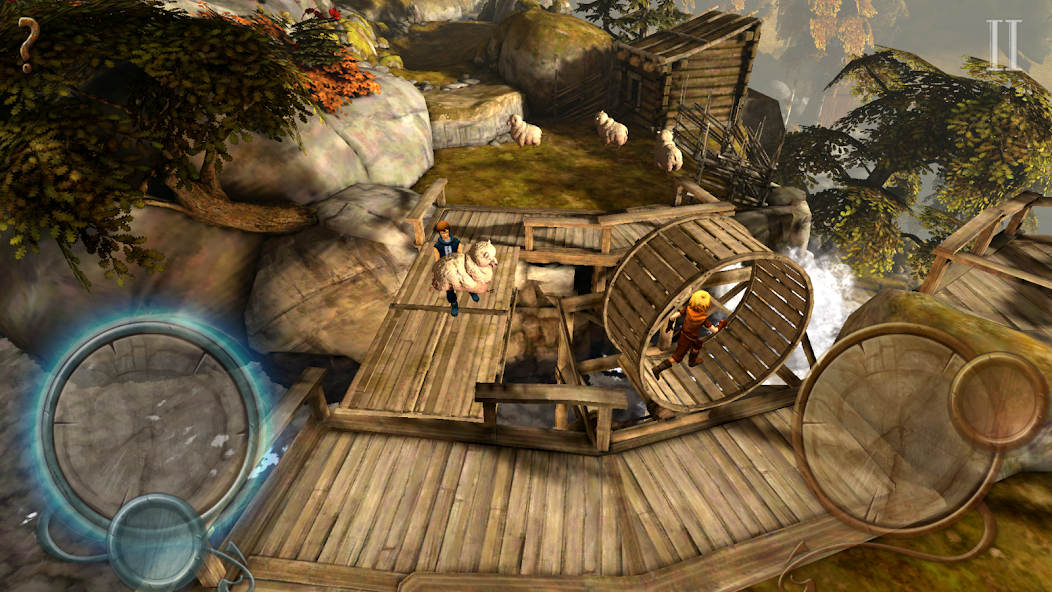
At its core, Brothers employs a unique two-character control system that rethinks single-player interaction by assigning each brother to a separate input. Typically the left and right controls correspond to the elder and younger sibling respectively, so players must think in parallel rather than sequentially. This design promotes tactile cooperation: one brother might hold an object while the other pulls a lever, or both might synchronize movement to balance on unstable platforms. The control scheme also influences puzzle design, because many solutions require simultaneous timing, independent actions, or asymmetrical abilities between the characters. Controls are intentionally simple; movement, basic interactions, and context-sensitive actions reduce friction and keep focus on coordination and story progression. The camera is largely cinematic, following set pathways to frame emotional beats and environmental details, which means players experience a curated sense of scale and moment rather than unrestricted exploration. Environmental puzzles vary in style, from physics-driven tasks and traversal challenges to more reflective sequences that emphasize timing and presence. Combat is minimal and treated as a narrative tool rather than a dominant mechanic, often resolved through clever use of positioning and movement rather than complex offensive inputs. Because the game limits mechanical complexity, it rewards careful observation and experimentation; noticing how objects respond, how terrain shifts, and when to switch emphasis between brothers becomes the core skill. This approachable mechanical surface masks finely tuned level design: each scene scaffolds new variations on core ideas, gently increasing difficulty while offering moments of discovery. The result is a gameplay loop that feels cohesive with the story—both brothers must cooperate to overcome obstacles, and players mirror that partnership through the control scheme. This marriage of control and design creates memorable set pieces and a satisfying learning curve that aligns emotional investment with mechanical proficiency. It remains accessible and rewarding.
The storytelling in Brothers is deliberately minimalistic yet deeply evocative, relying on visual language, gesture, and music to convey plot and character. Dialogue is mostly absent; instead the game uses invented vocal sounds, expressive animations, and carefully framed sequences to communicate emotion and intention. This approach invites players to infer motivations, read relationships, and participate actively in meaning-making rather than receiving explicit exposition. Central themes include sibling bonds, sacrifice, the pains of growing up, and confronting loss; these are explored through small interactive moments that accumulate into a moving character arc. Each brother has a different physical presence and implied personality—the elder offers guidance and strength, while the younger brings innocence and vulnerability—and the gameplay repeatedly asks players to balance these qualities. Symbolism appears throughout: landscapes, weather, and creatures often mirror inner states or escalate stakes without heavy-handed narration. The climax and denouement are structured to provoke reflection, with scenes that resonate differently depending on the player's interpretation and emotional state. By treating players as co-authors of the narrative experience, the game fosters personal investment: a simple act of holding a brother's hand or carrying him across a gap can feel profoundly meaningful because of what it represents within the story's moral texture. Themes are never spelled out; instead the game trusts the player's emotional intelligence to assemble significance from context and pacing. That restraint allows for moments of quiet sorrow, sudden joy, and bittersweet resolution that feel earned rather than manufactured. The soundtrack complements this restraint, swelling at key moments and receding during intimate beats, while visual composition often uses scale and isolation to underline vulnerability. The overall narrative design favors affective truth over plot complexity, yielding an experience that lingers because it taps into universal human experiences rather than specific cultural references. Many players describe it as powerful.
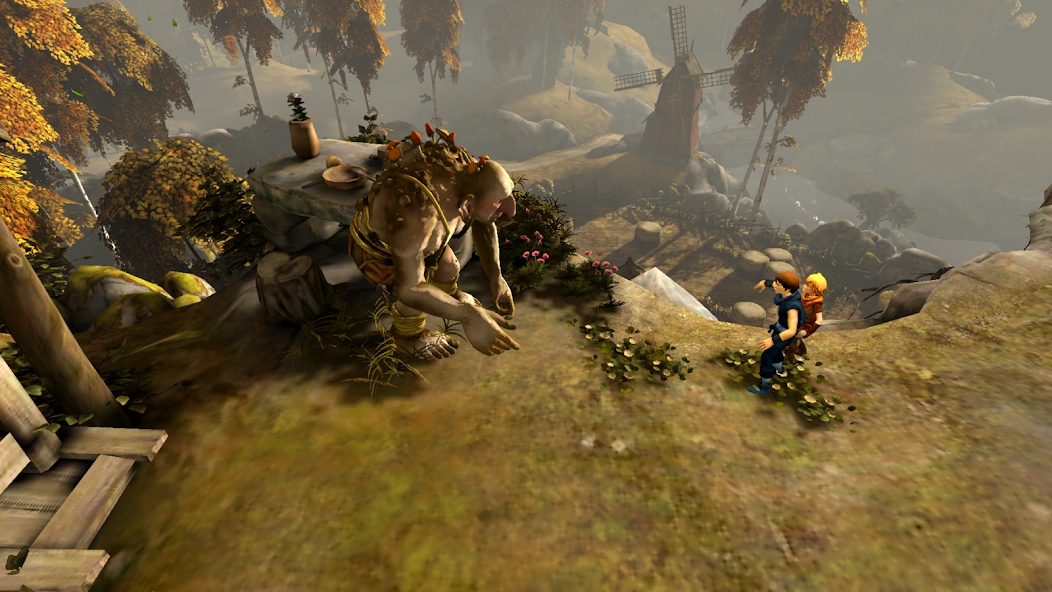
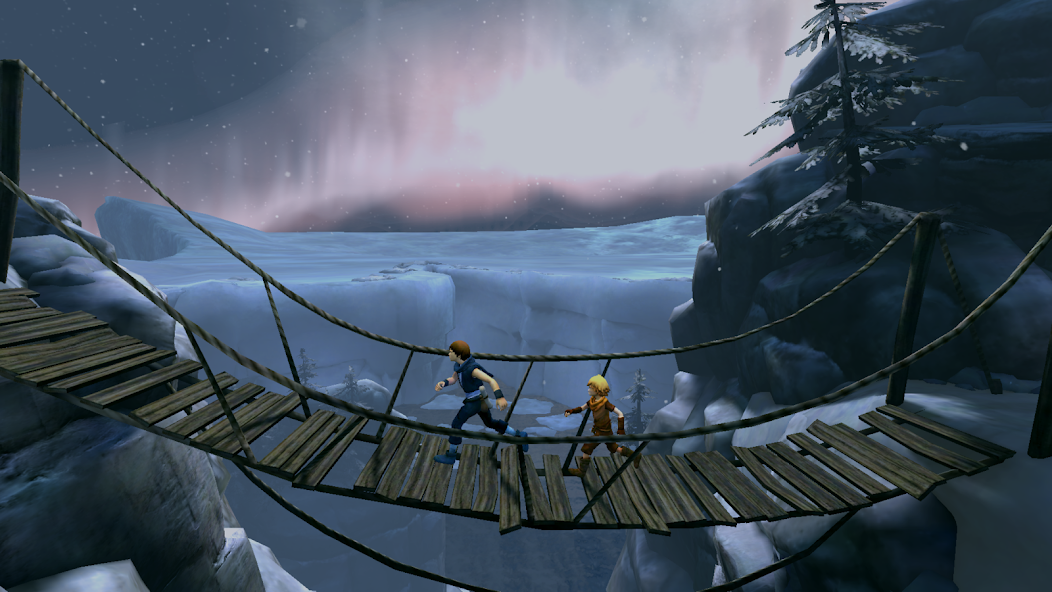
Visually, Brothers blends painterly environments with realistic textures to create landscapes that feel both grounded and mythic. Art direction favors wide vistas, muted color palettes punctuated by warmer tones during intimate moments, and carefully designed set pieces that guide the eye toward interactive elements and emotional anchors. Character models are expressive without relying on hyperreal detail, allowing gestures and posture to communicate personality and mood. Lighting plays a significant role in establishing atmosphere—fog, shafts of light, and the contrast between shadowed interiors and open fields help signal tone shifts and narrative beats. The game's animation is fluid and purposeful; the way the brothers move together, stumble, or assist each other reinforces the core theme of cooperation. On the audio side, the score serves as a narrative voice, swelling during discoveries and receding during reflective interludes. Compositional choices often mirror on-screen events, using instrumentation and thematic motifs to reinforce character dynamics or to foreshadow emotional turns. Environmental sound design complements the music, from subtle footsteps and rustling foliage to distant ambient effects that give locations a lived-in feel. The absence of conventional dialogue places more weight on these auditory elements, making them essential for emotional clarity and pacing. Technically, the game favors cinematic presentation over open-world complexity: levels are structured to support a focused sequence of interactions and camera framing, allowing developers to craft precise visual and auditory moments. Performance considerations were balanced against aesthetic goals; animations and environmental effects are tuned to preserve immersion without overwhelming gameplay responsiveness. The result is a cohesive audiovisual experience where sight and sound work in tandem to tell a story that feels intimate and cinematic. Players often recall specific musical cues or visual moments long after playing, a testament to the deliberate integration of artistic and technical design choices throughout the title, and production.
Since its release, Brothers has been cited frequently in discussions about storytelling in games, praised for how mechanics and narrative align to produce emotional resonance without relying on extensive text or exposition. Critics and many players highlighted its bold control scheme, emotional clarity, and concise structure; awards and nominations recognized both the design innovation and the emotional impact of the piece. The game's compact length makes it approachable for players who prefer focused experiences, and its emphasis on empathy and cooperation has led educators and scholars to reference it as an example of ludic design reinforcing theme. Accessibility considerations were mixed in discussions: while the simplified input reduces mechanical barriers, the reliance on simultaneous coordination can challenge some players, prompting conversations about alternative control mappings and assistive options in similar projects. Brothers also influenced subsequent designers who sought to combine meaningful mechanics with narrative intent, appearing in curriculum and postmortem analyses as a case study of how player action can embody story. The title's legacy includes direct influences on small studios and narrative-driven projects that experiment with unconventional controls or silent storytelling. In community discourse, memorable scenes and musical motifs are often cited when fans explain why the game impacted them personally, underlining the cultural footprint of its moments. For prospective players, those who enjoy reflective, emotionally charged adventures with puzzle-oriented progression will likely find it rewarding; players seeking long-form exploration or intricate combat may prefer different genres. Beyond entertainment, the game continues to be discussed in academic and design circles for its contributions to interactive narrative theory and experimental control schemes. Its sustained presence in conversations about game design demonstrates that concise, well-executed ideas can produce lasting impressions and influence creative practice across the medium. It stands as an example of small teams innovating with focused, expressive design regularly.
How to Get Started with Brothers: A Tale of Two Sons?
- 1. **Platform Selection**: Choose your gaming platform (PC, Xbox, PlayStation, Nintendo Switch).
- 2. **Purchase the Game**: Buy the game through digital storefronts (Steam, PlayStation Store, Xbox Store, Nintendo eShop) or physical copies.
- 3. **Install the Game**: Download and install the game on your chosen platform.
- 4. **Familiarize with Controls**: Check the control scheme in the options menu to understand how to control both brothers.
- 5. **Start the Game**: Launch the game and begin the story.
- 6. **Follow the Tutorial**: Pay attention to the initial tutorial to understand gameplay mechanics, such as controlling both brothers and their unique abilities.
- 7. **Explore the Environment**: Take time to explore each area for collectibles and story elements.
- 8. **Solve Puzzles**: Engage with the game’s puzzles using both brothers’ abilities to progress through the story.
- 9. **Enjoy the Story**: Immerse yourself in the narrative and character development as you play.
- 10. **Save Progress**: Regularly check the save points to ensure your progress is saved.
10 Pro Tips for Brothers: A Tale of Two Sons Users
- 1. **Explore Every Corner**: Take your time exploring the environment to find hidden items and puzzles. Interaction with the surroundings often reveals crucial elements for progress.
- 2. **Use Each Brother's Strengths**: Utilize the unique abilities of each brother. The elder brother can handle heavier tasks, while the younger brother can access smaller spaces.
- 3. **Cooperative Gameplay**: Take advantage of the co-op mechanics, even in single-player mode. Control both brothers to solve puzzles that require teamwork.
- 4. **Observe the Environment**: Pay attention to visual cues and environmental storytelling. Clues are often embedded in the scenery to guide your journey.
- 5. **Emotional Connection**: Engage with the storyline and immerse yourself in the narrative. The emotional depth enhances the gameplay experience.
- 6. **Puzzle Strategies**: Tackle puzzles methodically. Sometimes stepping back and observing the entire situation helps in finding solutions you might overlook.
- 7. **Timing Matters**: Some puzzles require precise timing. Coordinate your brothers' movements carefully to execute actions in sync.
- 8. **Keep an Eye Out for Collectibles**: Look for items that provide backstory or enhance your experience. They are often hidden in less obvious spots.
- 9. **Trial and Error**: Don't hesitate to experiment with different approaches to puzzles. Failure can often lead to new insights.
- 10. **Engage with NPCs**: Interacting with non-playable characters can provide hints or enrich the storyline, so make sure to engage with them when possible.
The Best Hidden Features in Brothers: A Tale of Two Sons
- 1. **Dual Control Mechanics**: Players control two brothers simultaneously, navigating puzzles and obstacles that require coordination between both characters.
- 2. **Environmental Storytelling**: Background elements reveal the story, with clues about the brothers' past and the world they inhabit without the need for dialogue.
- 3. **Emotional Interactions**: Moments of connection, such as hugs or helping each other up, enhance the emotional weight of the journey.
- 4. **Unique Abilities**: Each brother has distinct abilities—one is stronger, while the other is more agile—encouraging players to use both effectively.
- 5. **Hidden Areas and Collectibles**: Exploring off the beaten path can unveil hidden items, lore, and bonuses that deepen the gameplay experience.
- 6. **Animal Encounters**: Players can interact with various animals throughout the game, leading to unique moments that offer emotional resonance.
- 7. **Cinematic Camera Angles**: The camera often shifts to enhance storytelling, providing dramatic perspectives during key moments or transitions.
- 8. **Symbolic Imagery**: Certain visual motifs, like the recurring use of water and reflection, hold deeper meaning, contributing to the narrative's themes of loss and hope.
Brothers: A Tale of Two Sons Faqs
How do I control both brothers in the game?
You can control both brothers simultaneously using the joystick or touch controls. Each brother has unique abilities, so be mindful of their strengths and how they can interact with the environment.
What should I do if I get stuck on a puzzle?
If you find yourself stuck, take a moment to explore the area. Look for hints in the environment, as puzzles often require specific actions from both brothers. Sometimes, switching characters can reveal new solutions.
Can I switch characters at any time during the game?
Yes, you can switch between the two brothers at any time. This is essential for solving puzzles and overcoming obstacles, as each brother has different skills necessary for various challenges.
What are the unique abilities of each brother?
The older brother can interact with larger objects and use physical strength, while the younger brother can fit into tight spaces and is more agile. Use their abilities together to solve puzzles and progress through the game.
How do I progress in the game if I face a challenging section?
If you encounter a challenging section, try these steps: 1. Analyze the environment for clues. 2. Experiment with both brothers’ abilities. 3. Switch characters strategically to utilize their strengths. 4. Take a break and return with a fresh perspective.

 HappyMod